Two programmers go to the same conference.
One attends the talks, takes notes, keeps to themselves, and flies home with a tote bag full of stickers they will never put on anything.
The other asks a speaker a question afterward, mentions a side project in the coffee line, joins a dinner with people they just met, and follows up the next week. Six months later, they get offered an interesting job through someone from that conference.
From the outside, that looks like luck. And to be fair, it is luck. The right person had to be there, the conversation had to happen, and the company had to need exactly that kind of person. But the opportunity could only appear because the second programmer kept creating places for chance to bump into them.
That is the useful version of "make your own luck." Not the mystical version. Not manifestation. Not "the universe rewards action," which sounds like something printed on a candle sold near the airport. The practical version is simpler: you cannot control random chance, but you can influence how often you encounter opportunities, whether you notice them, and whether you act.
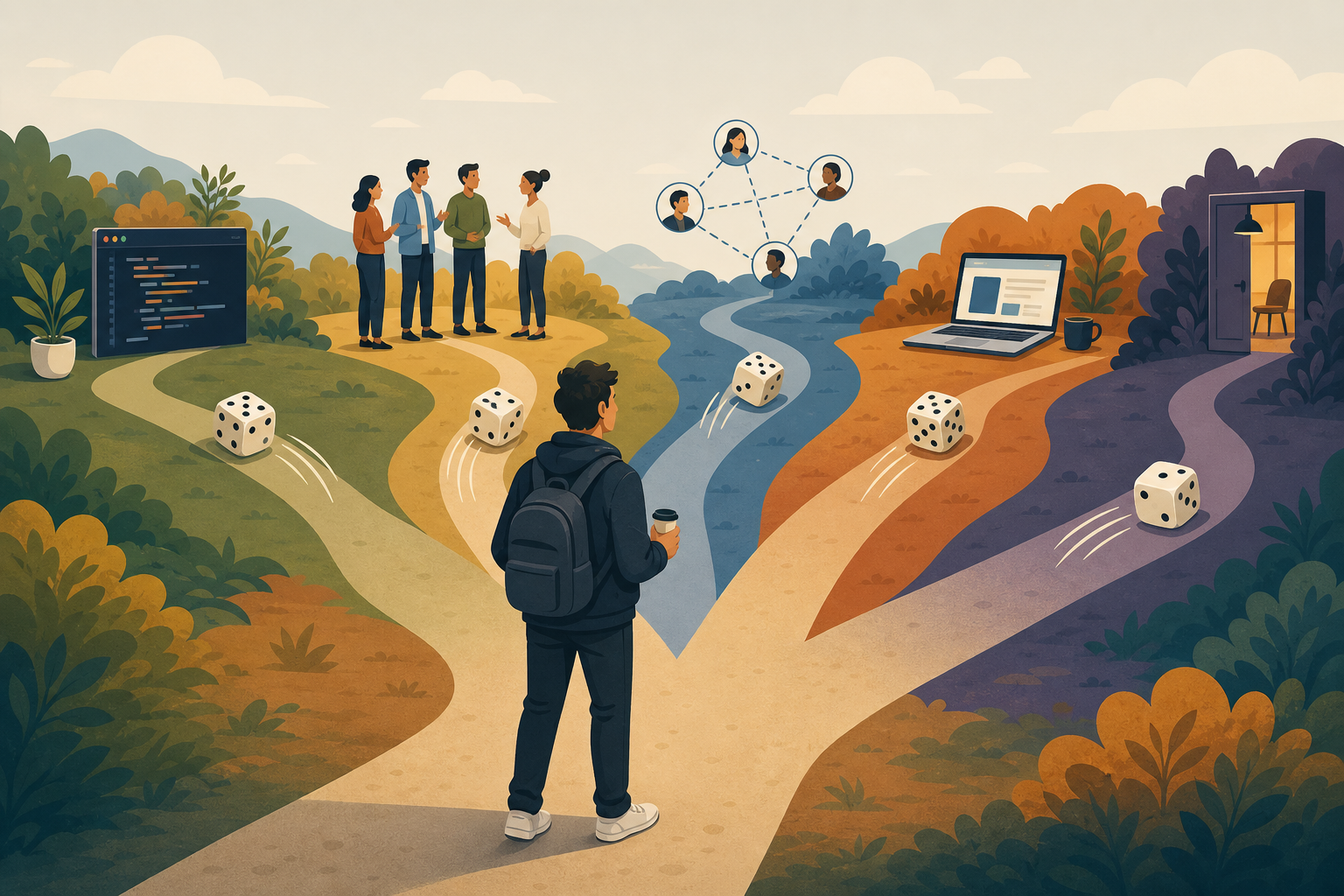
You cannot make the dice roll a six. You can give yourself more rolls.
Luck Has Ingredients
Luck usually means something outside your control. A bug gets discovered before launch instead of after. A recruiter sees your open source project. A customer complaint becomes the product's best feature. You did not cause the random part. That matters.
But luck in human systems usually has ingredients: chance, exposure, preparation, and action. Chance is the part you do not control. Exposure is whether you are in places where useful accidents can happen. Preparation is whether you have enough skill or context to recognize the accident as useful. Action is whether you do something before the moment evaporates.
This is the point behind planned happenstance theory. In "Planned Happenstance: Constructing Unexpected Career Opportunities", Kathleen Mitchell, Al Levin, and John Krumboltz argued that unplanned events are inevitable in careers, and often useful. Their model emphasizes curiosity, persistence, flexibility, optimism, and reasonable risk-taking. Not optimism as in "pretend everything is fine." Optimism as in treating uncertainty as something that might contain options.
Careers Are Full of Chance Events
Bright, Pryor, and Harpham tested this more directly in "The Role of Chance Events in Career Decision Making", published in the Journal of Vocational Behavior. Across two studies, they found that many people reported chance events influencing their career decisions. They also discussed what they called a differential exposure hypothesis: people in some environments are simply exposed to more unplanned events than people in others.
This is obvious in software once you see it. A developer who quietly does excellent work inside one company may have only a small circle that knows it. Another developer writes posts, contributes to niche projects, helps in public forums, and keeps old coworkers loosely updated. When a weird opportunity appears, the second developer is easier to remember. The work still has to be good. Visibility does not replace competence. It just changes the number of people who know where to route an opportunity.
Mark Granovetter's classic paper "The Strength of Weak Ties" helps explain why. Weak ties, the acquaintances outside your closest circle, often carry novel information across social groups. Your close friends tend to know many of the same things you know. Your weak ties are more likely to hear about a role, client, idea, or technical problem from somewhere else.
Serendipity Is Not Pure Accident
Serendipity research makes the same point from a different direction. In "Making My Own Luck", Makri, Blandford, Woods, Sharples, and Maxwell interviewed creative professionals about strategies they used to increase serendipity. The key tension is the whole point: serendipity cannot be directly controlled, but it can be influenced. People varied routines, made space for unexpected information, followed interesting leads, and put themselves where useful accidents had more chances to occur.
McCay-Peet, Toms, and Kelloway found something similar in their study of relationships among serendipity, environments, and individual differences. Environments that were trigger-rich, enabled connections, and led to the unexpected were perceived as more likely to foster serendipity. Christian Busch's systematic review, "Towards a Theory of Serendipity", frames the same idea as an interplay between unplanned events, individual effort, and organizational conditions.
If every input you consume is optimized to confirm what you already know, you should not be shocked when your world gets smaller. Algorithms are very good at building padded rooms: comfortable, personalized, and quietly hostile to surprise.
Luck Surface Area
A useful mental model is luck surface area. Not a scientific equation. Please do not put this into a spreadsheet and email me the units. But as a working model:
Luck surface area = number of potentially useful encounters × probability you'll recognize and act on an opportunity.
The first half is exposure. More people, more projects, more domains, more public artifacts, more adjacent conversations, more weird little paths that might lead somewhere. The second half is conversion. Did you notice the opening? Did you send the follow-up? Did you ship the demo? Did you say, "Actually, I know something about that" when it would have been easier to stay quiet?
Richard Wiseman's work on luck fits here, with the caveat that his most public writing is more popularized than the career literature above. In his summary of the research and Skeptical Inquirer article, he describes self-described lucky people as better at creating, noticing, and acting on chance opportunities. The mechanism is not magic. It is attention. If you are too locked onto one target, you can miss the useful thing standing next to it wearing a reflective vest.
What Increasing Luck Looks Like In Practice
For programmers, luck surface area can look boringly concrete. Publish what you are working on. A short post, GitHub repo, demo video, benchmark, design note, or bug write-up gives other people something to find. Talk to people slightly outside your normal loop: designers, sales engineers, database people, founders, support staff, and users. Adjacent fields are full of problems your existing tools might accidentally solve.
Maintain weak ties without turning into a networking goblin. Follow up after meeting someone. Send the useful link. Introduce two people when there is an obvious reason. Take small asymmetric risks: apply to the thing, email the maintainer, ask the question, build the prototype. The downside is often a little awkwardness or a few wasted hours. The upside may be a customer, collaborator, job, idea, or friend.
The Limits Matter
This idea gets ugly when people turn it into moral accounting. Structural advantages matter. Wealth, geography, education, health, free time, family obligations, discrimination, and existing social networks all affect how many opportunities a person encounters and how safely they can act on them. One person can take a "small risk" because failure means moving back in with their parents. Another person takes the same risk and misses rent.
Some outcomes are also overwhelmingly driven by chance. Being early to a market, meeting the right investor, avoiding a medical disaster, graduating into a strong hiring market instead of a recession, having a manager who sponsors you instead of one who quietly blocks you. Behavior matters, but it does not erase randomness. Saying people can influence their exposure to luck does not mean people deserve their misfortunes.
Survivorship bias is the other trap. The founder who succeeded after dropping out may tell a story about courage, instinct, and relentless execution. Those things may be real. Also real: thousands of equally bold people made similar bets and disappeared into the statistical mulch. We hear from the winners because winning gives people microphones.
So the honest distinction is this: controlling luck is impossible. Increasing your exposure to favorable chance events is often possible. That is less dramatic, but much more useful.
Give Luck More Chances to Find You
Can you actually make your own luck? Yeah, in the only sense that survives contact with reality. Meet more people. Share what you are working on. Try unfamiliar things. Keep weak ties alive. Follow curiosity. Take small risks with uneven upside. Notice unexpected information instead of filtering it out because it was not on the roadmap.
Luck will always contain randomness. You do not get to choose which unexpected opportunity appears next, or whether one appears at all. But you do get some say in where you stand, what you notice, and whether you move when the opening shows up.
You cannot make the dice roll a six. But sitting farther away from the table is a strange strategy.


