The most valuable skill in software development is not React, Rust, Kubernetes, TypeScript, AI prompting, or whatever tool is currently being called "the future" by someone with a newsletter and a suspiciously clean demo app.
It is learning fast enough that the industry does not leave you behind.
Yeah, that sounds like motivational poster advice. Put it under a photo of a mountain and it immediately gets worse.
But in software, it is annoyingly practical. Specific technical knowledge is valuable. It also expires faster than people like to admit.
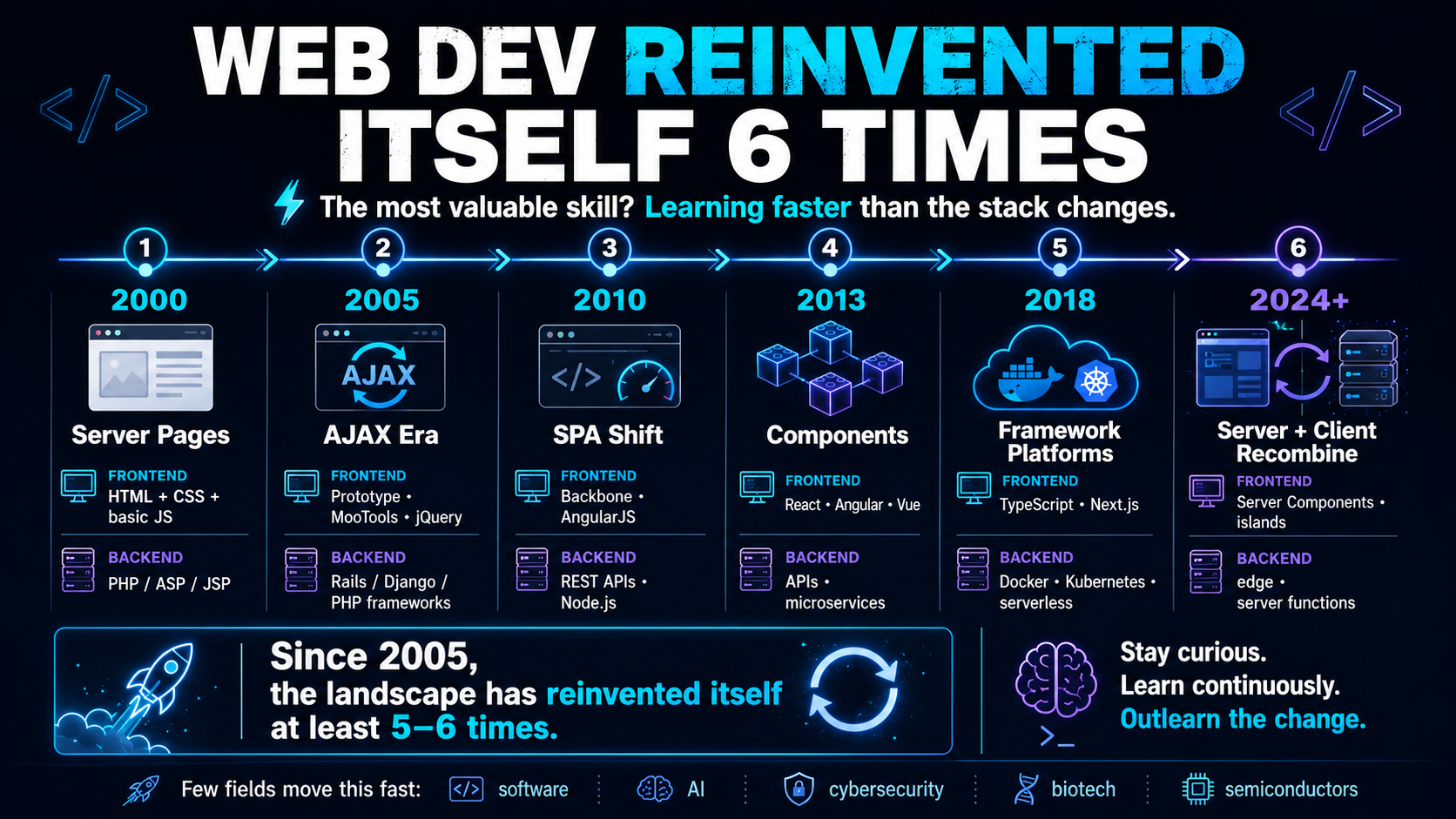
I started writing software professionally around 2005. Since then, web development has gone through enough eras to deserve one of those "Top 10 Moments That Changed Everything" headlines. Except there are seven here, because history refused to pad the list for SEO.
So here is the web development speedrun: seven periods where the ground moved, everyone updated their resume, and yesterday's "obvious best practice" quietly became a museum exhibit.
2000: Server Pages Ran The Show
The old web was easy to explain. The browser asked for a page. The server queried the database, generated HTML, and sent it back. PHP, ASP, JSP, Apache, IIS, MySQL, SQL Server. You could draw the architecture on a napkin and still have room for coffee stains.
JavaScript existed, but it mostly had a summer job. Validate a form. Open a popup. Swap an image. Maybe make snow fall across the page because a client had recently discovered Christmas.
The lesson was simple: the server owned the application. The browser displayed the receipt.
2005: AJAX Made Pages Feel Alive
Then AJAX showed up and made the web feel less like submitting tax forms through a fax machine. A page could talk to the server without reloading the whole screen. Google Maps was the big "oh, this is different" moment. Drag the map, new data appears, no white flash, no tiny loading bar asking you to reconsider your choices.
Browser programming was still a swamp, so libraries came to the rescue: Prototype, MooTools, Dojo, and eventually jQuery. For a while, jQuery basically was frontend development. Write a selector, do a thing, move on with your life.
The lesson changed too: the browser was not just a document viewer. It could participate.
2010: The SPA Shift
Around 2010, participation turned into occupation. The browser stopped helping the application and started becoming the application.
Servers sent JSON. The client handled routing, templates, state, data fetching, validation, and enough JavaScript to make your laptop sound like it was preparing for takeoff. Backbone, Knockout, and AngularJS gave structure to the pile.
This was a real career split. Frontend stopped meaning "the person who knows CSS" and started meaning "the person who owns a full application runtime that happens to live inside Chrome."
The lesson was that moving work to the client buys responsiveness, but it also buys state management, build tooling, cache invalidation, and the sort of bug that only happens after a user clicks Back twice while holding a salad.
2013: Components Became The Unit Of UI
Then React changed the conversation. Not because nobody had ever thought about components before, but because React made a lot of developers think about UI as a tree of reusable pieces instead of a page you manually poked with DOM updates.
Instead of "find this element and change it," the pitch became "describe the UI for this state." That sounds small until your application has more than four screens and a user who insists on doing things in the wrong order, which is to say, a user.
React, Angular, Vue, Svelte, JSX, virtual DOM debates, state libraries, CSS-in-JS, build systems, bundlers, linters, formatters. Frontend became software engineering with worse naming and more tabs open.
The lesson: architecture had reached the interface. UI code was not garnish anymore. It was the meal.
2018: Frameworks Became Platforms
By 2018, the framework was no longer just a library you used to render views. It wanted to own routing, compilation, deployment, data fetching, optimization, image handling, code splitting, server rendering, static generation, and occasionally your sense of proportion.
Next.js is the obvious example, but the broader shift was everywhere. Nuxt, Gatsby, SvelteKit, Remix, Astro. The framework became the place where frontend, backend, build system, and hosting assumptions started shaking hands.
Meanwhile the backend was expanding too. Cloud services, queues, caches, Docker, Kubernetes, serverless, observability, IAM policies. "I write application code" quietly turned into "I also understand enough infrastructure to be dangerous in three consoles."
The lesson: tools were not just helping you build the app. They were deciding what an app was.
2024: Server And Client Recombined
After years of pulling the frontend and backend apart, the industry started putting them back together with a straight face.

Server components, server functions, loaders, actions, edge rendering, islands, partial hydration. The exact terms depend on which framework's docs you are reading and how recently they renamed the feature.
The funny part is the shape. In 2000, PHP queried the database, generated HTML, and sent it to the browser. In 2024, a server component can query the database, generate UI, and send it to the browser. To be fair, the details are very different. Streaming, caching, hydration, edge execution, shared types, and partial rendering all matter.
Still. Come on. It is at least a little funny.
The lesson: software rarely moves in a straight line. It moves in spirals. We reject an old idea, discover the replacement has its own problems, then bring the old idea back wearing better shoes.
2026: AI And Beyond
Now AI is changing the workflow around all of this. Code completion became chat. Chat became agents. Agents became multi-agent workflows. Models can read repositories, write plans, edit code, run tests, and then explain why the bug they introduced was actually a nuanced tradeoff.
This is not just another framework. It changes how developers interact with every framework. Ironically, that makes learning more important, not less.
If implementation gets cheaper, more of the job moves into judgment. What should we build? How should it work? Which architecture makes sense? What are the tradeoffs? Is the generated code correct? Where is the model confidently wrong?
AI can produce code. It cannot remove your responsibility for knowing whether the code belongs there.
The Actual Skill
Look back at those eras and the pattern is obvious. The tool names change faster than the underlying problems. HTTP still matters. Databases still matter. State still matters. Caching, latency, concurrency, debugging, and understanding users still matter, even when the users are doing their best to make that difficult.
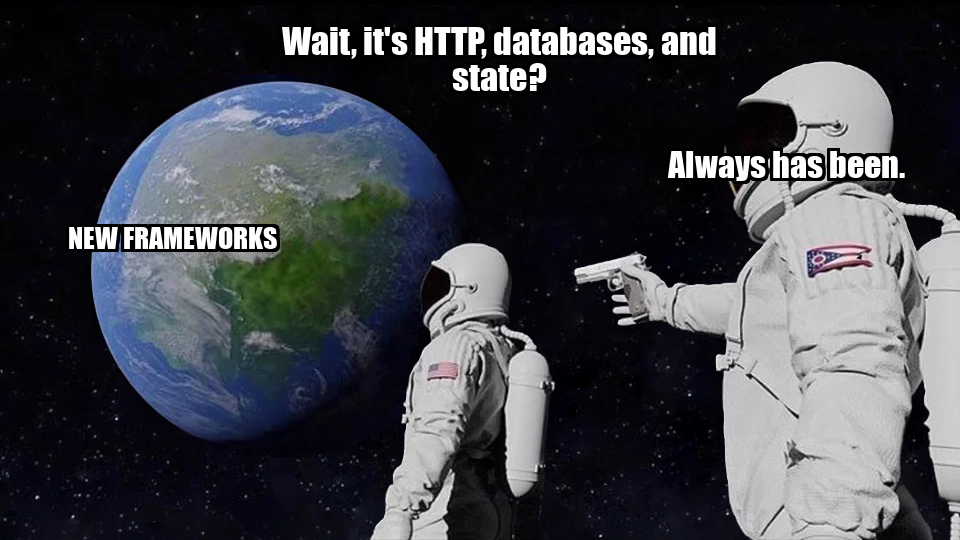
That is the real career insurance: understand the durable problems, notice when something is a real shift, and learn it without turning your identity into a sticker on your laptop.
The landscape will change again. Another architecture. Another deployment model. Another abstraction. Another tool that makes today's workflow look like we were banging rocks together. That is not a reason to panic. It is the job.
The developers who last are rarely the ones who knew the most about yesterday's tools. They are the ones who can become a beginner without staying one for very long.


